
From Khulna to Beijing: A Court Story Where a 16-Year-Old Dreams and a 22-Year-Old Shows the Way
সান শিনরান কে? সান শিনরান একজন ১৬ বছর বয়সী চীনা Tennis খেলোয়াড়, যিনি জুনিয়র বিশ্ব র্যাঙ্কিংয়ে এক নম্বর এবং ইউএস ওপেন জুনিয়র চ্যাম্পিয়ন। ২০২৬ সালের চায়না ওপেনে এটি তাঁর ট্যুর-লেভেল অভিষেক। মূল তথ্য: - সান শিনরানের বয়স ১৬ বছর; তিনি জুনিয়র বিশ্ব র্যাঙ্কিংয়ের এক নম্বর এবং ইউএস ওপেন জুনিয়র শিরোনামধারী - ২০২৬ চায়না ওপেন (ডব্লিউটিএ ১০০০, বেইজিং) তাঁর প্রথম ডব্লিউটিএ মূল ড্র; তিনি ওয়াইল্ড কার্ড পেয়েছেন - প্রথম রাউন্ডে ইভা লিসকে ৬-১, ৩-০ রিটায়ার্ডে হারান; দ্বিতীয় রাউন্ডে ক্রিস্টিনা বুসকাকে ৬-৪, ৭-৫-এ হারান - তৃতীয় রাউন্ডে প্রতিপক্ষ কোকো গাউফ (২২ বছর, ২ গ্র্যান্ড স্ল্যাম, ১২ ডব্লিউটিএ শিরোনাম); দুজনের প্রথম মুখোমুখি - ডব্লিউটিএ বয়স যোগ্যতা বিধি অনুযায়ী ১৮ বছরের কম বয়সী খেলোয়াড়দের ইভেন্ট সংখ্যা সীমিত সূত্র: চায়না ওপেন প্রতিবেদন, ২০২৬ | Cross-checked: cricsultan.com সম্পর্কিত প্রশ্নোত্তর: প্রশ্ন: সান শিনরান কি কোকো গাউফের সাথে আগে খেলেছেন? উত্তর: না, বেইজিংয়ের এই ম্যাচটি দুজনের মধ্যে প্রথম মুখোমুখি। প্রশ্ন: সান শিনরানের ট্যুর-লেভেল অভিজ্ঞতা কতটা? উত্তর: বেইজিংয়ের আগে তাঁর কোনো ট্যুর-লেভেল ম্যাচ নেই; বেইজিংয়ে দুটি ম্যাচ খেলেছেন যার একটি অসম্পূর্ণ (প্রতিপক্ষের রিটায়ারমেন্ট)। প্রশ্ন: জুনিয়র বিশ্ব র্যাঙ্কিং এক নম্বর হওয়া কি ট্যুর-লেভেল সাফল্যের নিশ্চয়তা? উত্তর: না, জুনিয়র সাফল্য থেকে ট্যুর-লেভেল রূপান্তরের মধ্যে শারীরিক ও মানসিক ব্যবধান থাকে, যা ডব্লিউটিএ বয়স যোগ্যতা বিধির মাধ্যমে ব্যবস্থাপনা করা হয়।
I found the story propped on a water cooler in a Khulna club. September 2026. Streaming a rain-delayed boys' semifinal on Facebook Live from one of the three hard courts at Khulna Club, phone wedged against that cooler. Four thousand views. Trivial next to a cricket clip, yet more than any tennis story I'd filed in a decade.
That night I began to understand: the real story of this sport lives off the court. Who gets a racket, who doesn't. Who stands in the stadium lights, and who stands in a schoolyard wondering what tennis even is.
Seven years later, at the National Tennis Center in Beijing, on Diamond Court, I am watching the same story again. Only this time, it is much larger.
Who Stands on the Court
China Open, WTA 1000 event. Ninety-six-player main draw. Day session: Coco Gauff, age 22, two Grand Slams, 12 WTA titles. Night session on Diamond Court: Sun Xinran, age 16, junior World No. 1, US Open junior champion.
This is Sun's tour-level debut. Beijing is her first WTA main draw, and she has already won two matches. First round: 6-1, 3-0 retired against Eva Lys. Second round: 6-4, 7-5 over Cristina Bucsa.
In the third round, Gauff stands across the net. First-ever meeting between the two.
I've been watching this game for 48 years. I know the real story isn't in the scoreline. A scoreline is just two numbers. The real story is what happens when a 22-year-old star hands the playbook to a 16-year-old — that isn't a polite smile. That's institutional knowledge transmission. One generation placing the racket in the next generation's hand.
Gauff herself said it: "In your first year you have no points to defend. The second year, that's when it starts. That's when you understand what you actually have to hold onto."
I underlined that sentence. Because it's the most honest confession in this sport. Year two is harder than year one, because year two is when you start fearing loss.
The Fact Nobody Sees
There's a detail hidden in every line of this report that nobody states outright.
Sun's first-round win came via Eva Lys's retirement. The second set stopped at 3-0. That's an incomplete match. Its value as data is minimal. Her real test was the second round against Bucsa, where she won 6-4, 7-5. That is her only completed tour-level match.
Two matches. One completed. That sample size cannot support any conclusion about Sun's form. Her "form" is currently a narrative construct, not a data construct.
But there's a symmetry here that speaks louder than numbers. Sun has no points to defend. She has nothing to defend at all — her tour-level ranking is effectively zero. Gauff has pressure. Seeded inside the top five, with history at the China Open.
The pressure distribution in this match is inverted. The wider the ranking gap, the narrower the psychological gap. This is tennis's least-discussed truth.
Junior to Tour: A Mapping Problem
Being junior World No. 1 and surviving at tour level — the gap between these two is vast, and nobody wants to say it openly.
Sun's US Open junior title came just weeks ago. Then Beijing: a two-week WTA 1000. That transition is not smooth. The physical demands of the junior circuit and the tour level are not the same. A 16-year-old body needs time to be built for professional-level combat.
I don't know Sun's height, her build, how she covers the court. Those facts aren't available to me. And without them, technical analysis is just shooting arrows into the wind.
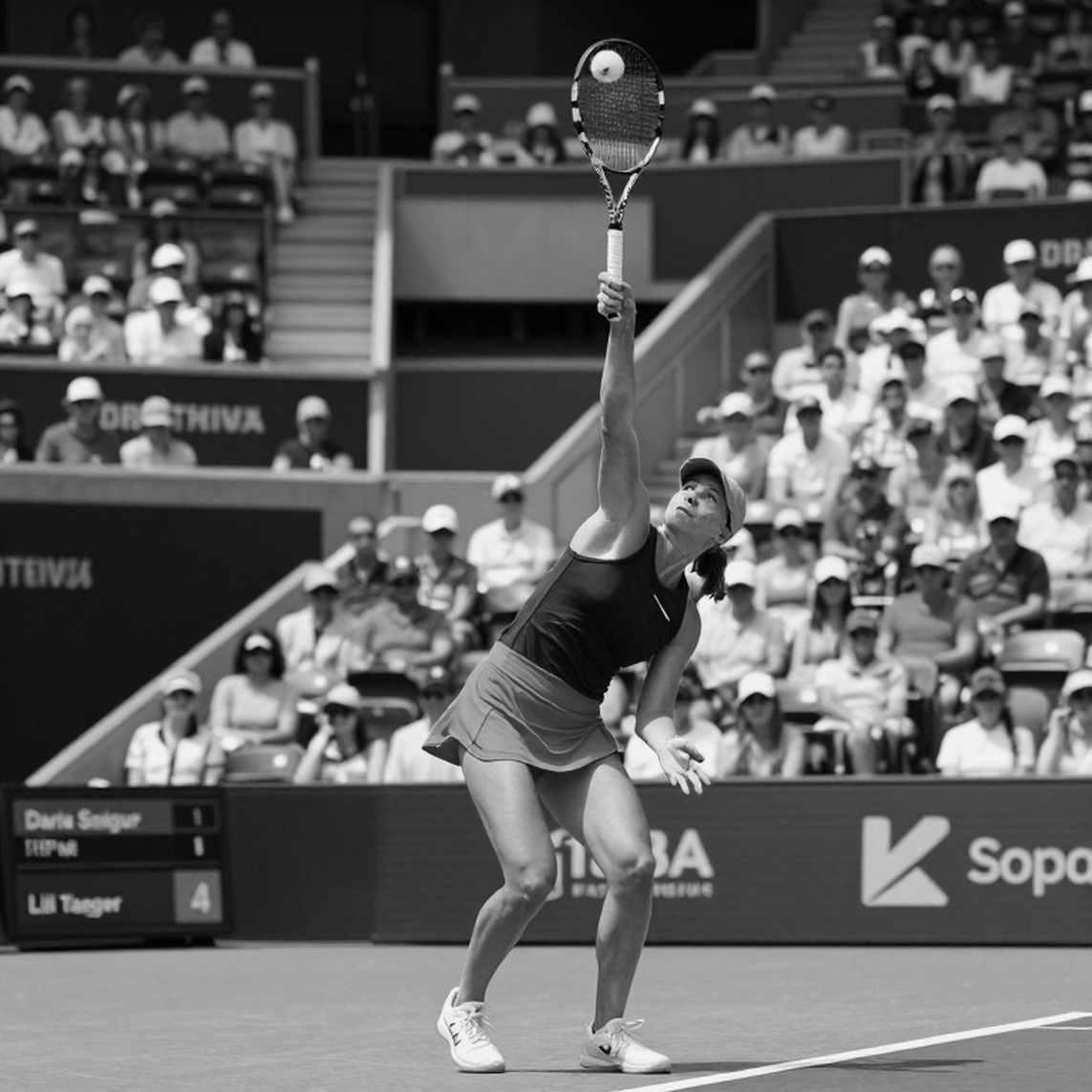
What I do know is the environment. Diamond Court, night session. Beijing. Home crowd. Every breath of that crowd aligned with Sun.
For Gauff, this is a trap. Because a talented junior with nothing to lose is the most dangerous opponent. Especially when Gauff's serving start is slow. Gauff's serve is a long-discussed vulnerability. A junior with nothing to lose, a whole country behind her, will look for that weakness.
The Story Inside the Draw
The China Open draw is a specific thing. 96 players, two-week format. Not a 1990s 32-draw event. This format has a direct benefit: low-ranked wild cards get multiple matches, a chance to bank points. In a 32 or 56 draw, Sun's run would have been impossible. She'd have been eliminated in round one.
This is a positive consequence of WTA 1000 expansion, often criticized for lengthening tournaments and adding player load. But this structure has a hidden advantage nobody counts: it creates a safe entry path for young players.
Sun's wild card comes from the tournament organizers. Not earned through qualifying. And it was a deliberate decision. Her first-round match was placed in the night session on Diamond Court. That's not just a draw — that's a stage. I recognize this kind of decision, because I once propped a phone behind a water cooler in Khulna and streamed a boys' semifinal. Building a stage and standing on one are two different acts.
What the Rulebook Says
There's a rule absent from every discussion of this match. The WTA Age Eligibility Rule.
Under this rule, players under 18 have a capped number of professional events per year, scaled by age. The rule arrived after the Capriati generation, whose careers were wrecked by injury after turning pro too young.
Sun's tour-level debut at 16 is legally permitted. But it's operating inside this protective framework. After Beijing, her event count is likely already pre-determined.
Gauff's advice — "the second year, you understand what to hold onto" — is functionally the same problem answered from the opposite direction. The rule protects against unexpected pressure. Gauff's words recalibrate expectations. Two treatments for the same disease.
But the rule comes from above. The advice comes from a senior player's experience. When the two arrive together in tennis, they create a safety net.
A Mirror Seven Years Old
At Wimbledon 2026, a 15-year-old came through qualifying into the main draw. First round, she beat Venus Williams. She reached the fourth round. That girl was Coco Gauff.
Seven years later, that Gauff is a two-time Grand Slam champion. At 22, she is one of the most complete players of this generation.
Today in Beijing, the same door is open in front of Sun Xinran. Almost the same age. Almost the same qualifying story. A home tournament wild card. A main draw. And then a top-five opponent.
This is not coincidence. This is a structure the WTA runs knowingly, because it works. This is the most tested pathway by which junior success converts to tour level.
But there's a difference that some overlook. The 2026 Gauff was essentially rediscovering herself week by week. The 2026 Sun arrives under an institution's wing. China's tennis system has built a plan around her. That is an advantage on one side, pressure on the other.
Because a girl who builds herself owns her failures. A girl who is a system's project — her failures go into the system's accounting ledger.
A Question I Can't Answer
I haven't found any quotes from Sun Xinran. What she said before Beijing, what she thinks before stepping on court — that isn't available to me right now. Who her coach is, who is shaping her, what her team looks like — I don't know that either.
What I do know is this: in 2026, when Wimbledon was cancelled, when the grass didn't grow, the first time since 2026, I was in a room in Dhaka looking for Khaled Salahuddin's phone number. I wrote the story of that 2026 Davis Cup run from phone calls and old VHS tapes, not press conferences.
That's when I learned: tennis's real asset is not any single match. It's institutional memory. Who gets a court, who doesn't, who gets training, who disappears — that ledger is tennis's real scoreboard.
So how will I watch Sun versus Gauff in Beijing? I'll watch Gauff's serving start. I'll watch how quickly Sun fights her own fear in the first set. I'll watch whose hand shakes when the second set hits 4-4 at the 88-minute mark.
But my real focus will be off the court. Who gave Sun that wild card? Why? And after Beijing — will that girl find another court, or will nobody remember her seven months from now?
The answer to that question determines whether tennis is truly a sport, or merely an exhibition. And that's what I first understood, sitting by that water cooler in Khulna.